Tuesday, January 23, 2024

The Rebirth of Trace Creek

The Valleyist Papers


A COLLECTION OF ESSAYS WRITTEN IN FAVOUR OF THE IMPROVEMENT OF STEPHENS VALLEY

Author – William Ray


Edition 3. Issue 02.

This month we turn our attention to Trace Creek and how it is being “re-booted” by a team of experts, led by Cumberland River Compact. It should be noted that this article borrows heavily from the description of the Trace Creek project on the Compact’s webpage at https://cumberlandrivercompact.org/2023/11/20/restoring-a-historic-stream-along-the-natchez-trace/ . The Valleyist is simply taking a lot of their information and transforming it for the residents of Stephens Valley. 

For the residents, it is well known that Trace Creek is troubled. When we look at the fork of the creek that runs through the middle of Jackson Falls, cross the creek on the covered bridge, or walk along beside the creek on one of the trails, we see that the banks are actively eroding and choked with invasive species of non-native vines, shrubs, and trees. We also see a creek that has a curiously straight alignment in many sections. Mother Nature rarely uses straight lines. We also note that the creek is devoid of life, so, although we are not environmental engineers, we know our home creek is ailing. The state of Tennessee agrees and has proclaimed Trace Creek as a distressed stream.  

Trace Creek runs about four miles – including two miles through Stephens Valley – before flowing into the Harpeth River, taking with it the eroded soil and degraded water quality from just upstream. The creek arises near the old Stephens homestead at the end of Pasquo Road, formed by some local springs and runoff from the hills that carry the Natchez Trace. It builds along Pasquo and then parallels Carsten Street and Glenrock Drive, before leaving SV along Sneed Road, and then turns to go under Sneed then along Temple Road, going under Highway 100 on its way to empty into the Harpeth River. For over twenty years, the Tennessee Division of Water has reported that Trace Creek “insufficiently supports aquatic life” due to the loss of natural habitat and pollution from silt, due largely to agricultural run-off. 

While Trace Creek is likely tens of thousands of years old, for most of its existence the stream slowly evolved with its surrounding environment, until more recent years when that environment changedOver time, Trace Creek evolved to carry an expected amount of water and sediment from the surrounding watershed to downstream waterwaysA rich diversity of plants and animals called Trace Creek home, and these species evolved right along with it.   

Historically the creek would have been home to a rich array of aquatic and wetlands species. Further, migratory animals that are declining in population today would have fed on the aquatic life, and enjoyed plentiful support from mature tulip poplar trees, American sycamores, oaks, and other plants within Trace Creek’s healthy floodplainBut the changes brought by farming the rich floor of the valley took precedence over the health of the creekSince natural meandering streams slow down plowing, planting, and harvesting, common agricultural solutions were implemented. The creek was rerouted and straightened to redirect it to the squared edges of the farm fields. Many decades ago, this practice knocked the stream out of equilibrium with its surrounding environment, and Trace Creek went into decline. 

After the creek’s realignment, and after the completion of the northern terminus of Natchez Trace Parkway, the volume and velocity of water and sediment draining from the watershed and moving through the creek channel became dramatically different. The alterations set into motion accelerating issues with erosion and habitat loss. Within the stream, ecologically critical species of macroinvertebrates (insects in their nymph and larval stages such as snails and crayfish that spend at least part of their lives in water) were buried beneath the muck. Newly exposed soil along the banks and atop the floodplains were colonized by highly invasive, non-native plants which our local insects, birds, and animals have not evolved to eat. The food supply which is needed by the local animals continues to dwindle as invasive species choke out native habitat. 

Thankfully, this bleak scene is not going to end in despair. The development of Stephens Valley has made the Compact’s Compensatory Stream Mitigation Program viable for Trace Creek. As Land Innovations and Rochford Realty and Construction Company were planning SV, they had to evaluate comprehensive stormwater solutions for Stephens Valley to get regulatory approval of the project we now call home. In that process, it became apparent that Trace Creek had some major issues already, and the construction of SV would not improve the lot of Trace Creek without affirmative action to do so. Their search for solutions that would find favor with the Williamson County authorities led them to Cumberland River Compact, and that was very fortunate for the developers and for Trace Creek. The Cumberland River Compact specializes in small and large-scale stream restoration projects across the Cumberland River basin. Previous projects include the Richland Creek dam removal at McCabe Golf Course, Moss Wright Bank Stabilization project in Goodlettsville, and stream restoration on the west fork of the Red River at Billy Dunlop Park in Clarksville.  

Trace Creek in Stephens Valley will be one of the largest, suburban stream restoration projects in Tennessee history. Nearly 14,000 feet of stream (2.6 miles) will be restored and permanently protected by a conservation easement. Since we stated earlier that Trace Creek is four miles long, the restoration will obviously not extend all the way along Temple Road to the Harpeth River (behind our Publix on Highway 100)But even the non-restored sections of the creek will benefit from the 2.6 miles of restoration around our homes.  

Maybe we’ve talked enough about the history of Trace Creek and how it came to be troubled. Now let’s talk about the restoration project that is happening before our eyes here in SV. As we walk and drive around the neighborhood, work is being done to improve water quality, mitigate habitat loss to protect fish and wildlife, and increase the public's ability to use the channel for fishing and other recreational activities.  

As this is written, the creek is being returned to an alignment that honors its original routeThough many trees must be cut down to do this work, as many as possible are being recycled to construct in-stream habitat – riffles, toewood, log rollers, and more will be included in the rebirth of Trace Creek. Herbaceous plant seed, willow shoots, and biodegradable fiber matting will help keep soils in place as construction crews complete this step. If you stop and observe the work for a few minutes, you cannot help but notice that they are using materials from the valley such as rock, logs, and native plants to help slow down stormwater flow and restore the natural meander of curve pattern found in stable streams like Trace Creek was originally. It is also very interesting to see the technology being used in the project. For example, look at the large trackhoes doing most of the work and note the two GPS antennae mounted on their turrets.  


These units communicate with the GPS unit presently on a tripod near the garden plots and allow the machine and operator to reshape Trace Creek according to the plans, without the need for extensive surveying and staking of the construction project. The plans developed for the project are downloaded to the machines and the precise depth of each earth-moving action is dictated by the GPS units. Pretty amazing, eh? 

Following construction, the floodplains surrounding the creek will be planted with tens of thousands of native trees and shrubs and hundreds of pounds of native grass and flower seed – black willows, water oaks, tulip poplars; elderberries, silky dogwoods, and spicebush; big bluestem grass, lance-leaved coreopsis, and brown-eyed susans are only a few of several dozen unique species being planted. 

As this work is done, we will have a front row seat for the rebirth of the Trace Creek ecosystem. As the mud bottom of the creek is replaced with rock and as the stream is relieved of the choking invasive species of plants, the quality of the water will improve. We will soon see aquatic plants and insects return. After that crayfish and the larval/nymph forms of insects that have an aquatic cycle to their life cycle will return, and our creek will again live. It is expected that Cumberland River Compact will also take these tools and help attract small fish species to the creek, which will enhance our bird watching opportunities and the bird species that specialize in living on those fish and insect larvae will also return. We have all of this ahead of us, and it is really exciting! Perhaps, in a few years, we will be teaching our children to fish right here in the neighborhood.  

The Cumberland River Compact has set aside funding to monitor and adaptively manage in-stream conditions and streamside vegetation at the site for seven years to ensure its ecological success. After seven years, the site will be permanently protected and monitored by the Compact within a conservation easement. 

We are all lucky to get Trace Creek re-gifted to us by everyone involved in this rebirth. This is a treat for all of us and our senses. The reborn creek will give us beautiful vistas that we didn’t know we were going to get. Further, the creek, reborn with its flows, riffles and plunge pools, will give us an audible gift – the song born in running water, which will complement the bells we enjoy from Saint Matthew Catholic Church. Along with the sights and sounds, we should also find solace and comfort from the way the creek will improve.

We have described how a stream is being reborn by the introduction of impediments to its structure.  Perhaps we can all find hope in this lesson being laid out before us. Are there any of us that are not also facing new challenges and changes to our lives in SV? Is it possible that we have been looking at those challenges and changes too negatively? Maybe our challenges are being put in place such that we can be reborn along with Trace Creek.

My fellow Kentuckian, Wendell Berry described the process of facing impediments to our lives well, when he said: “There are, it seems, two muses: the Muse of Inspiration, who gives us inarticulate visions and desires, and the Muse of Realization, who returns again and again to say, "It is yet more difficult than you thought." This is the muse of form. It may be then that form serves us best when it works as an obstruction, to baffle us and deflect our intended course. It may be that when we no longer know what to do, we have come to our real work and when we no longer know which way to go, we have begun our real journey. The mind that is not baffled is not employed. The impeded stream is the one that sings.” 


Tuesday, December 26, 2023

Stephens Valley Garbage Disposal Issues

The Valleyist Papers


A COLLECTION OF ESSAYS 

WRITTEN IN FAVOUR OF THE IMPROVEMENT OF STEPHENS VALLEY

Author – Jo House, PE


Edition 3. Issue 01.

Introduction

Christmas in Stephens Valley is a season that is focused on gift giving, family gatherings and worshiping at your local church or synagogue. The last thing on any person’s mind is the collection and disposal of garbage. However, this is the busiest time of year for the generation of household trash. The week after Christmas is literally overwhelming at landfills which leads to this discussion of trash.

It could be argued that garbage disposal, aka solid waste disposal, is one of the least interesting and most disgusting aspects of any civilization. After all, garbage is smelly and nasty and most people don’t want to be anywhere near it whether it is in a container or landfill. However, solid waste management, as it is formally referenced, along with water treatment, and wastewater treatment are the three services necessary for a healthy community. Almost every community in Tennessee prior to 1990 had a dump where citizens could deliver their trash. The management of each dump was different in that some dumps buried the trash in trenches dug down as far as the equipment could dig and others simply spread it out on the surface of the ground and covered it occasionally with soil. Open burning of trash was also a convenient way of managing the volume of disposal.

Development of Solid Waste Zoning and Regulations

There were regulations in Tennessee for the operation and permitting of landfills prior to 1990, but those regulations did not address all the potential impacts to human health and the environment that could result from a poorly operated “dump”. However, the regulations in Tennessee began changing in 1988. The change was initiated in response to a proposal by a group of individuals who proposed to permit a household waste landfill in the southwest corner of Dickson County that adjoined Humphreys and Hickman County. The negative reaction to the proposed landfill resulted in state senator Doug Jackson formulating a bill to basically give municipal and county governments the ability to control siting of landfills in rural communities without zoning laws and ordinances. The legislation developed by Doug Jackson was promulgated on June 2, 1989 and was designated as the Jackson Law. However, for the law to be in effect it had to be adopted with a majority vote of the governing body of a county or city government. Basically, upon adoption of the Jackson law, all cities and counties were provided with the arbitrary and capricious right of refusal of any proposed landfill regardless of the protective quality of the design or location. It also could stop expansions of any landfills permitted after June 2, 1989.

In 1990, the Tennessee Division of Solid Waste Management (TDSWM) adopted a draft set of solid waste regulations developed by the Environmental Protection Agency (EPA) for the design, permitting, and operation of landfills. The final set of solid waste regulations were adopted in 1993 and were referenced as the Subtitle D landfill regulations. These regulations set forth minimum landfill design, operation, and monitoring requirements that would provide an acceptable level of risk relative to human health and the environment. These regulations were specifically designed to protect groundwater resources. Upon promulgation of the Subtitle D landfill regulations, it was believed that the requirements set forth in the regulations provided a level of protection for human health and the environment that the Jackson Law was no longer necessary and could be rescinded. 

Additional local zoning and environmental regulations that landfills must comply with are as follows:

Local Government

Regional Solid Waste Board

County and Municipal Government Zoning

Municipal Government Stormwater Regulations

Municipal Government Air Boards in Memphis, Nashville, Knoxville, Chattanooga

Tennessee Department of Environment and Conservation

Tennessee Division of Solid Waste Management

Tennessee Division of Water Resources

Tennessee Division of Natural Resources

United States Environmental Protection Agency (USEPA)

New Source Performance Standards and Emissions Guidelines

Greenhouse Gas Emissions 

National Pollutant Discharge Elimination System (NPDES) Stormwater Regulations

United States Federal Aviation Administration

United States Army Corp of Engineers

Waste Generation and Disposal in Stephens Valley and all Middle Tennessee

A conservative estimate of the volume of trash generated in middle Tennessee each day approximates 8,700 tons (some estimate the daily trash generation volume closer to 10,000 tons). The reported remaining disposal capacity of all landfills in middle Tennessee approximates 29,477,691 cubic yards. Using all the reported waste generation rates, the currently remaining permitted landfill capacity volumetrics along with the reported in place density of the waste, the remaining life of all landfills in middle Tennessee is 8.3 years. This estimate does not include consideration for the continued population growth in middle Tennessee. So, if all things remain 8,000 to 10,000 tons will have to be shipped long distances every day. (FYI – the railroad is not a viable solution) 

It may be noted that some of the landfills could possibly be expanded. The Middle Point Landfill just north of Murfreesboro is the largest landfill in Middle Tennessee and has provided disposal for one third of the trash generated in middle Tennessee and the majority of Nashville trash generated in Nashville. However, Middle Point has recently lost law suit seeking permission for an expansion. As a result, it is estimated that at the current rate of waste acceptance Middle Point will reach the permitted disposal capacity in 4 years and will have to close. The Bi-County Landfill located just north of Clarksville can be expanded, but that landfill is primarily operated to serve the citizens of Montgomery and Stewart County. It is uncertain if the West Camden Landfill can be expanded at this time. Smith County may be able to expand its landfill at a significant cost due to the presence of sinkholes, wetlands, and streams in the immediate vicinity. The Cedar Ridge Landfill located near Lewisburg in Marshall County is situated at a location with shallow bedrock which makes the design of expansions difficult and provides less soil for construction of liners and covers.

In summary, the potential for permitting a new landfill in middle Tennessee is extremely low due to the adoption of the Jackson Law by most county and municipal governments in Tennessee. As previously discussed, the Jackson Law provides all county and municipal governments the arbitrary and capricious right to refuse any proposal to permit a new landfill or expand an existing landfill permitted after June 2, 1989. Unfortunately, although there have been and are continuing to be attempts to develop and implement other technologies to manage the generation and management of solid waste the landfill remains the most practical and reliable option.

Landfill Containment Design

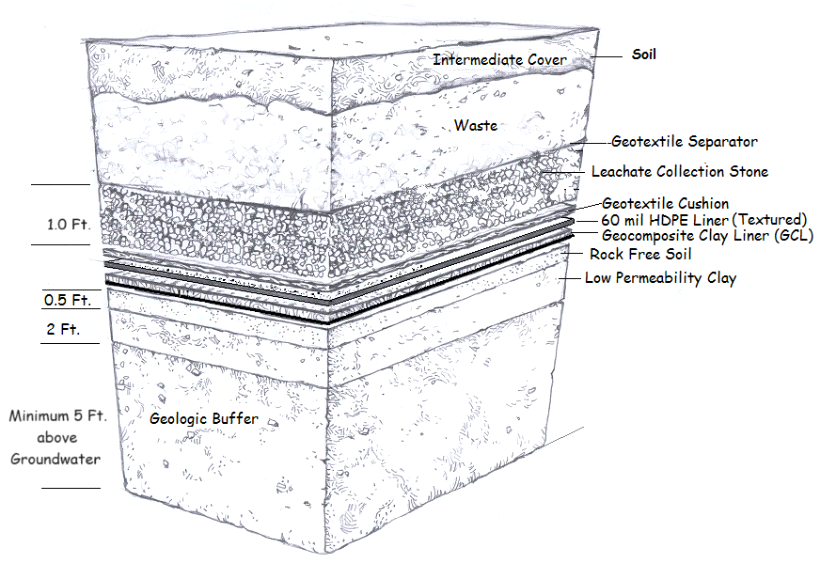
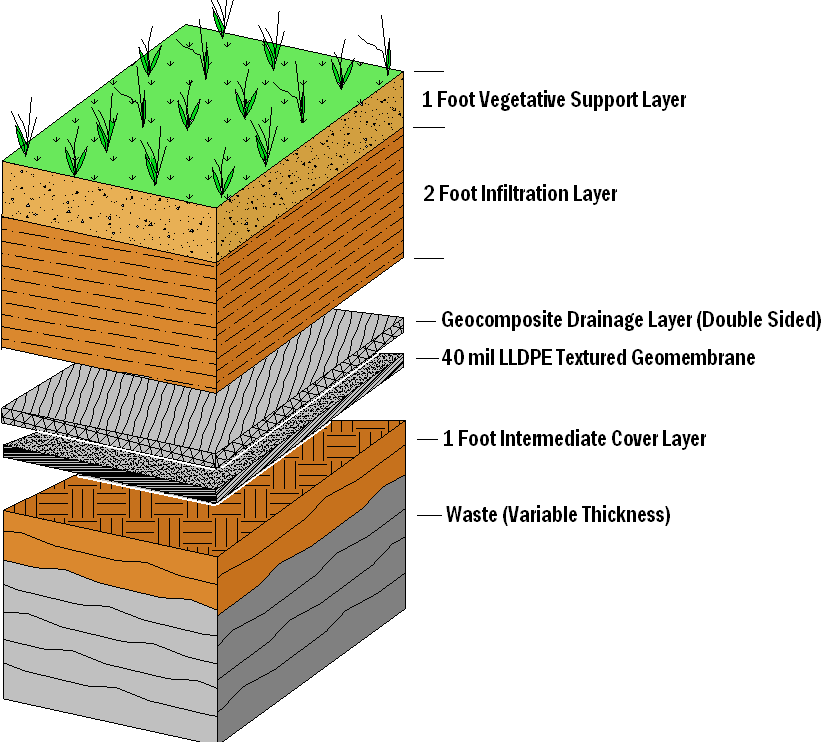
Landfills must be designed such that there is no release of constituents/pollutants from the waste mass. Specifically, all landfills are tasked with the collection and proper disposal of all liquids/rainwater that enters the landfill. This liquid is referred to as leachate and must be disposed of with an acceptable technology or at a wastewater treatment facility. In addition, landfills must collect and properly dispose of the gas generated from anaerobes that metabolize the organic fraction of the waste. The gas can be converted to electricity and can be scrubbed and used to operate vehicles used at the landfill. In addition, the landfill gas can be piped directly to industrial consumers. 


Typical Section of a Landfill Final Cover and Liner/Leachate Collection Barrier System

Alternate Disposal Technologies

There are several alternative solid waste disposal technologies that have been developed to replace landfilling and incineration. These alternatives have been developed to minimize environmental impact, promoting resource recovery, and reducing the overall volume of waste. However, many of these technologies work best in the laboratory and on a small scale. The cost to construct and operate alternate waste management technologies has limited widespread implementation. Those technologies are as follows: 

Waste-to-Energy (WtE):

Incineration: Converts solid waste into heat, electricity, or steam. Advanced incineration technologies can be designed to minimize emissions and recover energy.

Gasification: Converts waste into syngas, which can be used for energy production or as a chemical feedstock. It is considered more environmentally friendly than traditional incineration.

Anaerobic Digestion:

Biological Process: Breaks down organic waste in the absence of oxygen, producing biogas (methane and carbon dioxide) and nutrient-rich digestate. Biogas can be used for energy, and digestate can be used as fertilizer.

Pyrolysis:

Thermal Decomposition: Heats waste in the absence of oxygen, producing biochar, oil, and gas. Biochar can be used as a soil amendment, and the oil and gas can be used for energy.

Plasma Gasification:

High-Temperature Process: Uses a plasma torch to convert waste into syngas with minimal emissions. It can handle various types of waste, including hazardous materials.

Mechanical Biological Treatment (MBT):

Combination of Mechanical and Biological Processes: Involves sorting, shredding, and treating waste with biological processes to recover materials and produce a more stable residue for landfilling.

Hydrothermal Carbonization (HTC):

Wet Thermal Conversion: Converts organic waste into a carbon-rich material through high-temperature and high-pressure water treatment. The resulting hydrochar can be used as a solid fuel or soil conditioner.

Landfill Mining:

Extraction of Resources from Landfills: Involves the excavation of old landfills to recover valuable materials, such as metals, plastics, and soil. It can reduce the environmental impact of landfills and promote resource recovery.

Recycling and Material Recovery:

Source Separation: Encourages separation of recyclable materials at the source to improve the efficiency of recycling processes.

Advanced Sorting Technologies: Utilizes advanced technologies such as robotics and artificial intelligence for more efficient sorting and recycling of materials.

Waste Reduction and Prevention:

Zero Waste Initiatives: Focus on reducing waste at the source through sustainable product design, consumption patterns, and lifestyle choices.

Many solid waste facilities are continually evaluating the efficacy of alternate technologies or even a combination of these technologies. 

For example, the Williamson County Solid Waste Department had an issue with the disposal of large quantities of leachate so in 2000 they designed and implemented an aerobic bioreactor. An existing six-acre waste cell with a composite liner system was retrofitted with injection wells and piping such that the leachate could be injected into the waste mass from other areas of the landfill. Piping to convey the movement of air with large blowers into the waste mass was also installed which would keep the conditions for the generation of landfill gas to a minimum since landfill gas is produced under oxygen deficient environments. The bioreactor was operated for more than a decade successfully eliminating thousands of gallons of leachate and stabilizing the potential leaching of contaminants from the waste mass.

Brief Explanation of Recycling Technologies

The following paragraphs touch on the unintended consequences of recycling some of the most recycled materials.

Aluminum Recycling is probably the most economical form of recycling. However, the waste generated from the secondary smelter is comprised of salt, potash, volatile organic compounds, heavy metals, and large volumes of particulate matter/dust. There are two specific heavy metals (aluminum nitride and metallic aluminum) that are exothermic (produce heat) when introduced to water. If the secondary smelter waste is disposed of with household trash in a municipal solid waste landfill exposed to rainfall the aluminum nitride and metallic aluminum compounds begin to react and become hot enough to ignite the organic fraction of the waste. In addition, the reaction of those compounds results in the emission of ammonia gas at extremely high concentrations. Germany does not allow land disposal of this waste as it has developed technologies to remove the salt and potash for reuse. The process also reduces the concentration of heavy metals from the waste material. This technology has been entertained in the United States but has yet to be implemented due to economic restraints.

Cardboard Recycling

For clarification it should be noted that hardwood trees are not used for the manufacture of cardboard. Pine trees are grown as a crop for the manufacture of cardboard. However, cardboard recycling is an economically viable alternative that has environmental benefits. Nevertheless, recycling cardboard results in the generation of wastewater during pulping process, ink and adhesive removal processes that must be treated before discharge. Each time a box is recycled at a facility in Tennessee approximately 12% of that box ends up as wastewater discharge.

Plastics Recycling

Many concerned citizens have diligently been committed to separating plastics to comply with the proper protocols for the collection of plastics for recycling in an effort to minimize the impact of plastic pollution on plant and animal life most notably in the oceans around the world. Unfortunately, these efforts will make no noticeable impact at all due to several challenges which are as follows:

None of the challenges to plastics recycling is more daunting than the estimated 242 million metric tons of plastic generated in the world every year of which the United States is one of the top generators. 

Another major challenge is that the composition of plastics varies even in the same container which creates difficulties in the recycling process so that it is harder to isolate the base materials that can be recovered.

The recycling technologies for plastics also pose issues. Presently, chemical recycling has been touted as the promising new technology. Chemical recycling typically falls into two categories: plastic-to-fuel and plastic-to-chemical both of which use incineration. Plastic-to-fuel conversion involves pyrolysis or gasification, both of which use heat and chemical processes to break down plastic waste into products that are turned into fuels. The plastic-to-chemical process uses treatments such as heat and solvents to create feedstocks that proponents claim can be turned into other chemicals or new plastics. (Forbes July 2022) Each of these processes have impacts to human health and the environment as well as social and economic issues. The plastic-to-fuel technology generates toxic emissions including greenhouse gases when incinerated.

Basically, the challenges described above reduce to one conclusion which is that plastic recycling is just not economical. It's more often less expensive for companies to buy new plastic than it is to buy recycled plastic. Therefore, since it is less expensive for companies to buy new plastic there's not a huge market for recycled plastic. Additionally, China stopped buying U.S. plastic wastes in 2017 which basically destroyed the only viable market for recyclable plastic. 

Many environmentalists contend that the plastics industry has sold the public on the false narrative that plastics are recyclable, when in fact the process is prohibitively expensive, and few U.S. facilities have the capacity to do it. Specifically, California Attorney General Rob Bonta opened an investigation into the role petrochemical companies have had in misleading consumers. Another outspoken critic of the plastic recycling narrative is former EPA Regional Administrator and President of Beyond Plastics Judith Enck who stated that the plastics industry "must stop lying to the public about plastics recycling". "It does not work, it never will work, and no amount of false advertising will change that."

So, like numerous other well intended efforts to recycle waste the plastics collected for recycling also end up in landfills or are incinerated.

Concluding Remarks

While the Hudgins Disposal team does a wonderful job collecting our SV garbage, they transport it to a landfill, and that is becoming a big problem. Landfills are tasked with disposing of highly odorous and hard to manage waste materials whose generator is not accountable in any form or fashion. All complaints regarding the final disposition of odorous and hard to manage wastes are directed to the landfill who had no part in its generation. For years highly reactive wastes from secondary aluminum smelters, undigested sewage sludge from municipalities, and other industrial waste sludges with high concentrations of heavy metals have been delivered to landfills which upon delivery is no longer the responsibility of the generator to manage. Environmental groups and the public impacted by the operations undertaken by landfills never seem to even consider addressing the generator(s) whose waste can create issues once disposed.   

Hopefully, a technology will be developed to replace landfills but until that happens the primary technology for solid waste management is land disposal. However, the question is if a technology can be developed before the state of Tennessee is completely out of landfill disposal capacity since laws have been adopted that, for the most part, prohibit any new permitting of landfills in Tennessee. A day of reckoning is approaching for SV, and all of middle Tennessee. When we throw away our garbage, it isn’t really gone!

Author - Jo House, PE


Monday, November 27, 2023

Another Year in SV – Looking Back and Looking Ahead

The Valleyist Papers

A COLLECTION OF ESSAYS 

WRITTEN IN FAVOUR OF THE IMPROVEMENT OF STEPHENS VALLEY

Author – William Ray


Edition 2. Issue 12.

Another Year in SV – Looking Back and Looking Ahead

With Thanksgiving behind us and most of 2023 finished for us in Stephens Valley, it seems appropriate to examine what the year has brought us, and also look ahead some at what we might make of 2024. Whether this is your first, or your fifth Christmas season in Stephens Valley, you will certainly enjoy the Currier and Ives beauty of decorations applied to the architecture of the homes on our streets. Prepare to be proud of how much you have accomplished in finding your way to our place.

We made a lot of improvements to our community this year. A lot of new members of the SV community joined us in 2023, and they made our bonds stronger. It is hard to forget that early in 2023, Nashville experienced the heart-breaking horror of the murders at Covenant School, but it is also important that SV pulled together to help heal that wound. Many members of the community volunteered to walk next door to the Stephens Valley Church and run the vehicle parking operation during the funeral service for Mike Hill, one of those killed on March 27. That day brought many SV residents to know each other better as they served others. 

We also enjoyed some additional infrastructure provided by Rochford Realty and Construction. Trees, finished streets, and even new pickleball courts were provided for us, and we all are enjoying these amenities. But maybe the most valuable amenity for our goals of becoming a unique and rewarding community came with those new residents. The new residents moved into new homes, and most of those new homes came with SV’s most effective feature in the march toward community. Those homes came with front porches, which have mostly been adorned with porch swings and comfortable chairs. Perhaps the most valuable infrastructure we have in SV is those front porches – not the other features we expect from Rochford Realty and Construction.

To support that supposition, let us borrow heavily from the recent book by NY Times columnist and author, David Brooks – How to Know a Person: The Art of Seeing Others Deeply and Being Deeply Seen.  We didn’t move to SV, a community dedicated to fostering connections, by accident. We want to connect. Like most other members of the Homo Sapiens species, we long to have another person look into our faces with love and acceptance. Our problem is that we are not born with the practical knowledge about how to give one another the attention we crave, and the architecture of our neighborhood can only support these connections – not automatically provide it. We have to work in concert with our architecture, and since the Christmas season in SV will bring many opportunities for us to converse with each other, let’s consider David Brooks’s suggestions on how to make those conversations make good feelings consistent with the beauty that surrounds us. 

Brooks offers these suggestions that you can use during the upcoming social events, and at every opportunity thereafter. 

Be a loud listener. When another person is talking, you want to be listening so actively that you’re burning calories. Using responses like a congregant at a charismatic church is a great way to listen actively. Affirmations like “amen,” “aha” and “yes!” make you someone others want to talk to.

Storify whenever possible. Don’t just ask someone what they think about a subject. Instead, try: How did you come to believe that? That get them talking about the people and experiences that shaped their values. That gets them telling their story.

Do the looping, especially with adolescents. When we converse, we are not as clear as we think we are, and we are not as good at listening as we think we are. If someone tells you something important and then you paraphrase it back to them (what psychologists call “looping”) you can correct any misimpressions that might exist in the conversation. 

Turn your partner into a narrator. People mostly do not go into enough detail when they tell you a story. But, if you ask specific follow-up questions showing your interest in understanding the whole story, they will revisit the moment in a more concrete way and tell a richer story.

Don’t be a topper. If somebody tells you he is having trouble with a teenager, don’t turn around and say: “I know what you mean. I’m having incredible problems with my own son.” You might think you are trying to build a shared connection, but what you are really doing is shifting the attention back to yourself.

Obviously, what we're doing here is suggesting that you read the David Brooks book. His conclusions and advice are far too complex for me to summarize here. But it seems clear that his observation that we sometimes think that really great people perform the sorts of epic acts of altruism that might earn them Nobel Peace Prizes, when that isn’t really the case. The novelist and philosopher Iris Murdoch argued that the essential moral skill is being considerate to others in the complex circumstances of everyday life. Morality is about how we interact with each other minute by minute.

It seems that the SV community can be strengthened by following these suggestions from great writers and philosophers, and this simple advice from a guy who lives among you. Use your front porch. Listen for the bells of St. Matthew Catholic Church. Take in the stunning views of the SV homes and decorations that adorn them during the rest of 2023. Make coffee and take it to your front porch while you enjoy the view, and actively listen and see those who stroll down the sidewalk in front of your porch. Reward and congratulate yourself for being a member of the SV community by adding a chocolate biscotti (preferable from Trader Joe’s) to your front porch visit, and dipping said biscotti in the coffee. You deserve this gift! Oh, and have a wonderful Christmas!


The Electric Grid and Things We Should Talk About

  The Valleyist Papers     A COLLECTION OF ESSAYS WRITTEN IN FAVOUR OF THE IMPROVEMENT OF LIFE IN STEPHENS VALLEY   Author – William Ray   ...