Tuesday, December 26, 2023

Stephens Valley Garbage Disposal Issues

The Valleyist Papers


A COLLECTION OF ESSAYS 

WRITTEN IN FAVOUR OF THE IMPROVEMENT OF STEPHENS VALLEY

Author – Jo House, PE


Edition 3. Issue 01.

Introduction

Christmas in Stephens Valley is a season that is focused on gift giving, family gatherings and worshiping at your local church or synagogue. The last thing on any person’s mind is the collection and disposal of garbage. However, this is the busiest time of year for the generation of household trash. The week after Christmas is literally overwhelming at landfills which leads to this discussion of trash.

It could be argued that garbage disposal, aka solid waste disposal, is one of the least interesting and most disgusting aspects of any civilization. After all, garbage is smelly and nasty and most people don’t want to be anywhere near it whether it is in a container or landfill. However, solid waste management, as it is formally referenced, along with water treatment, and wastewater treatment are the three services necessary for a healthy community. Almost every community in Tennessee prior to 1990 had a dump where citizens could deliver their trash. The management of each dump was different in that some dumps buried the trash in trenches dug down as far as the equipment could dig and others simply spread it out on the surface of the ground and covered it occasionally with soil. Open burning of trash was also a convenient way of managing the volume of disposal.

Development of Solid Waste Zoning and Regulations

There were regulations in Tennessee for the operation and permitting of landfills prior to 1990, but those regulations did not address all the potential impacts to human health and the environment that could result from a poorly operated “dump”. However, the regulations in Tennessee began changing in 1988. The change was initiated in response to a proposal by a group of individuals who proposed to permit a household waste landfill in the southwest corner of Dickson County that adjoined Humphreys and Hickman County. The negative reaction to the proposed landfill resulted in state senator Doug Jackson formulating a bill to basically give municipal and county governments the ability to control siting of landfills in rural communities without zoning laws and ordinances. The legislation developed by Doug Jackson was promulgated on June 2, 1989 and was designated as the Jackson Law. However, for the law to be in effect it had to be adopted with a majority vote of the governing body of a county or city government. Basically, upon adoption of the Jackson law, all cities and counties were provided with the arbitrary and capricious right of refusal of any proposed landfill regardless of the protective quality of the design or location. It also could stop expansions of any landfills permitted after June 2, 1989.

In 1990, the Tennessee Division of Solid Waste Management (TDSWM) adopted a draft set of solid waste regulations developed by the Environmental Protection Agency (EPA) for the design, permitting, and operation of landfills. The final set of solid waste regulations were adopted in 1993 and were referenced as the Subtitle D landfill regulations. These regulations set forth minimum landfill design, operation, and monitoring requirements that would provide an acceptable level of risk relative to human health and the environment. These regulations were specifically designed to protect groundwater resources. Upon promulgation of the Subtitle D landfill regulations, it was believed that the requirements set forth in the regulations provided a level of protection for human health and the environment that the Jackson Law was no longer necessary and could be rescinded. 

Additional local zoning and environmental regulations that landfills must comply with are as follows:

Local Government

Regional Solid Waste Board

County and Municipal Government Zoning

Municipal Government Stormwater Regulations

Municipal Government Air Boards in Memphis, Nashville, Knoxville, Chattanooga

Tennessee Department of Environment and Conservation

Tennessee Division of Solid Waste Management

Tennessee Division of Water Resources

Tennessee Division of Natural Resources

United States Environmental Protection Agency (USEPA)

New Source Performance Standards and Emissions Guidelines

Greenhouse Gas Emissions 

National Pollutant Discharge Elimination System (NPDES) Stormwater Regulations

United States Federal Aviation Administration

United States Army Corp of Engineers

Waste Generation and Disposal in Stephens Valley and all Middle Tennessee

A conservative estimate of the volume of trash generated in middle Tennessee each day approximates 8,700 tons (some estimate the daily trash generation volume closer to 10,000 tons). The reported remaining disposal capacity of all landfills in middle Tennessee approximates 29,477,691 cubic yards. Using all the reported waste generation rates, the currently remaining permitted landfill capacity volumetrics along with the reported in place density of the waste, the remaining life of all landfills in middle Tennessee is 8.3 years. This estimate does not include consideration for the continued population growth in middle Tennessee. So, if all things remain 8,000 to 10,000 tons will have to be shipped long distances every day. (FYI – the railroad is not a viable solution) 

It may be noted that some of the landfills could possibly be expanded. The Middle Point Landfill just north of Murfreesboro is the largest landfill in Middle Tennessee and has provided disposal for one third of the trash generated in middle Tennessee and the majority of Nashville trash generated in Nashville. However, Middle Point has recently lost law suit seeking permission for an expansion. As a result, it is estimated that at the current rate of waste acceptance Middle Point will reach the permitted disposal capacity in 4 years and will have to close. The Bi-County Landfill located just north of Clarksville can be expanded, but that landfill is primarily operated to serve the citizens of Montgomery and Stewart County. It is uncertain if the West Camden Landfill can be expanded at this time. Smith County may be able to expand its landfill at a significant cost due to the presence of sinkholes, wetlands, and streams in the immediate vicinity. The Cedar Ridge Landfill located near Lewisburg in Marshall County is situated at a location with shallow bedrock which makes the design of expansions difficult and provides less soil for construction of liners and covers.

In summary, the potential for permitting a new landfill in middle Tennessee is extremely low due to the adoption of the Jackson Law by most county and municipal governments in Tennessee. As previously discussed, the Jackson Law provides all county and municipal governments the arbitrary and capricious right to refuse any proposal to permit a new landfill or expand an existing landfill permitted after June 2, 1989. Unfortunately, although there have been and are continuing to be attempts to develop and implement other technologies to manage the generation and management of solid waste the landfill remains the most practical and reliable option.

Landfill Containment Design

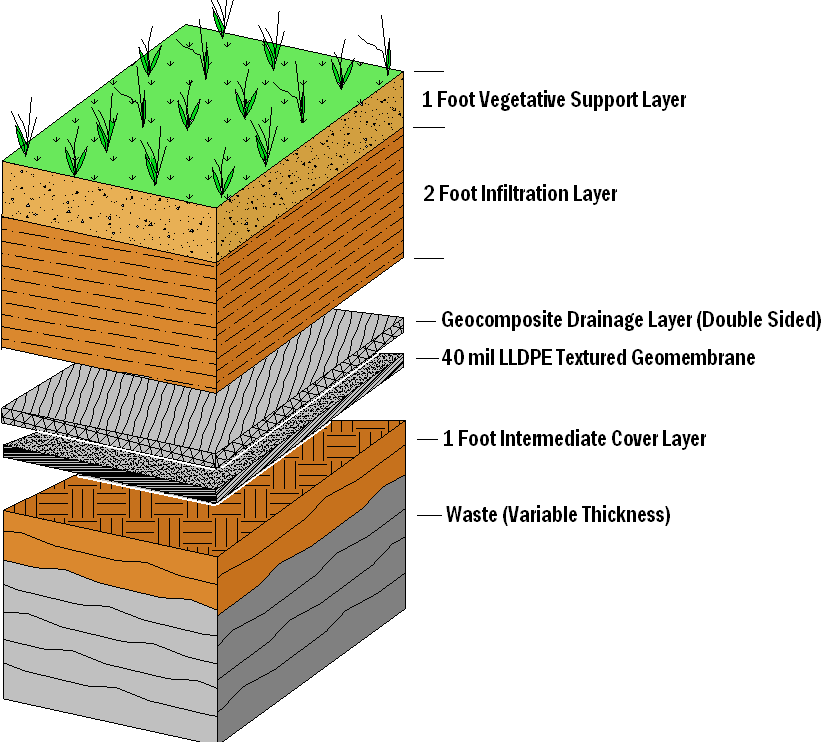
Landfills must be designed such that there is no release of constituents/pollutants from the waste mass. Specifically, all landfills are tasked with the collection and proper disposal of all liquids/rainwater that enters the landfill. This liquid is referred to as leachate and must be disposed of with an acceptable technology or at a wastewater treatment facility. In addition, landfills must collect and properly dispose of the gas generated from anaerobes that metabolize the organic fraction of the waste. The gas can be converted to electricity and can be scrubbed and used to operate vehicles used at the landfill. In addition, the landfill gas can be piped directly to industrial consumers. 
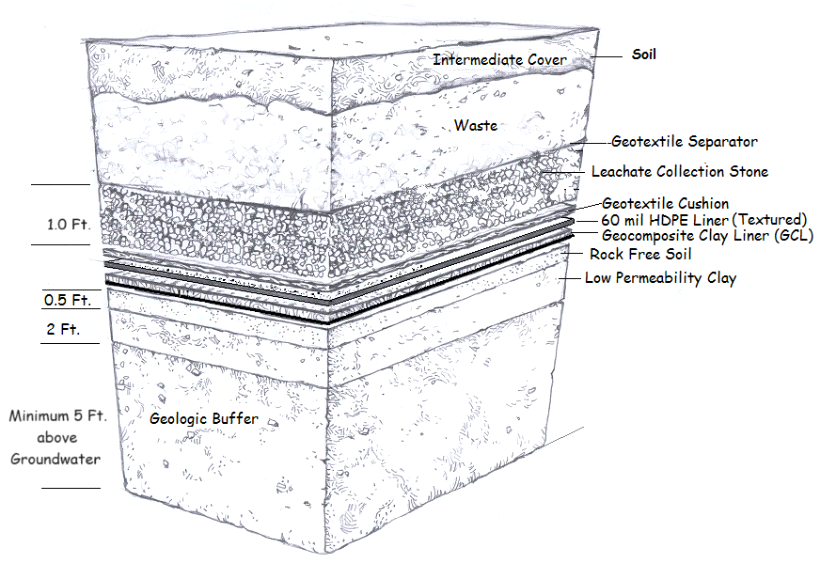


Typical Section of a Landfill Final Cover and Liner/Leachate Collection Barrier System

Alternate Disposal Technologies

There are several alternative solid waste disposal technologies that have been developed to replace landfilling and incineration. These alternatives have been developed to minimize environmental impact, promoting resource recovery, and reducing the overall volume of waste. However, many of these technologies work best in the laboratory and on a small scale. The cost to construct and operate alternate waste management technologies has limited widespread implementation. Those technologies are as follows: 

⦁ Waste-to-Energy (WtE):

⦁ Incineration: Converts solid waste into heat, electricity, or steam. Advanced incineration technologies can be designed to minimize emissions and recover energy.

⦁ Gasification: Converts waste into syngas, which can be used for energy production or as a chemical feedstock. It is considered more environmentally friendly than traditional incineration.

⦁ Anaerobic Digestion:

⦁ Biological Process: Breaks down organic waste in the absence of oxygen, producing biogas (methane and carbon dioxide) and nutrient-rich digestate. Biogas can be used for energy, and digestate can be used as fertilizer.

⦁ Pyrolysis:

⦁ Thermal Decomposition: Heats waste in the absence of oxygen, producing biochar, oil, and gas. Biochar can be used as a soil amendment, and the oil and gas can be used for energy.

⦁ Plasma Gasification:

⦁ High-Temperature Process: Uses a plasma torch to convert waste into syngas with minimal emissions. It can handle various types of waste, including hazardous materials.

⦁ Mechanical Biological Treatment (MBT):

⦁ Combination of Mechanical and Biological Processes: Involves sorting, shredding, and treating waste with biological processes to recover materials and produce a more stable residue for landfilling.

⦁ Hydrothermal Carbonization (HTC):

⦁ Wet Thermal Conversion: Converts organic waste into a carbon-rich material through high-temperature and high-pressure water treatment. The resulting hydrochar can be used as a solid fuel or soil conditioner.

⦁ Landfill Mining:

⦁ Extraction of Resources from Landfills: Involves the excavation of old landfills to recover valuable materials, such as metals, plastics, and soil. It can reduce the environmental impact of landfills and promote resource recovery.

⦁ Recycling and Material Recovery:

⦁ Source Separation: Encourages separation of recyclable materials at the source to improve the efficiency of recycling processes.

⦁ Advanced Sorting Technologies: Utilizes advanced technologies such as robotics and artificial intelligence for more efficient sorting and recycling of materials.

⦁ Waste Reduction and Prevention:

⦁ Zero Waste Initiatives: Focus on reducing waste at the source through sustainable product design, consumption patterns, and lifestyle choices.

Many solid waste facilities are continually evaluating the efficacy of alternate technologies or even a combination of these technologies. 

For example, the Williamson County Solid Waste Department had an issue with the disposal of large quantities of leachate so in 2000 they designed and implemented an aerobic bioreactor. An existing six-acre waste cell with a composite liner system was retrofitted with injection wells and piping such that the leachate could be injected into the waste mass from other areas of the landfill. Piping to convey the movement of air with large blowers into the waste mass was also installed which would keep the conditions for the generation of landfill gas to a minimum since landfill gas is produced under oxygen deficient environments. The bioreactor was operated for more than a decade successfully eliminating thousands of gallons of leachate and stabilizing the potential leaching of contaminants from the waste mass.

Brief Explanation of Recycling Technologies

The following paragraphs touch on the unintended consequences of recycling some of the most recycled materials.

Aluminum Recycling is probably the most economical form of recycling. However, the waste generated from the secondary smelter is comprised of salt, potash, volatile organic compounds, heavy metals, and large volumes of particulate matter/dust. There are two specific heavy metals (aluminum nitride and metallic aluminum) that are exothermic (produce heat) when introduced to water. If the secondary smelter waste is disposed of with household trash in a municipal solid waste landfill exposed to rainfall the aluminum nitride and metallic aluminum compounds begin to react and become hot enough to ignite the organic fraction of the waste. In addition, the reaction of those compounds results in the emission of ammonia gas at extremely high concentrations. Germany does not allow land disposal of this waste as it has developed technologies to remove the salt and potash for reuse. The process also reduces the concentration of heavy metals from the waste material. This technology has been entertained in the United States but has yet to be implemented due to economic restraints.

Cardboard Recycling

For clarification it should be noted that hardwood trees are not used for the manufacture of cardboard. Pine trees are grown as a crop for the manufacture of cardboard. However, cardboard recycling is an economically viable alternative that has environmental benefits. Nevertheless, recycling cardboard results in the generation of wastewater during pulping process, ink and adhesive removal processes that must be treated before discharge. Each time a box is recycled at a facility in Tennessee approximately 12% of that box ends up as wastewater discharge.

Plastics Recycling

Many concerned citizens have diligently been committed to separating plastics to comply with the proper protocols for the collection of plastics for recycling in an effort to minimize the impact of plastic pollution on plant and animal life most notably in the oceans around the world. Unfortunately, these efforts will make no noticeable impact at all due to several challenges which are as follows:

⦁ None of the challenges to plastics recycling is more daunting than the estimated 242 million metric tons of plastic generated in the world every year of which the United States is one of the top generators. 

⦁ Another major challenge is that the composition of plastics varies even in the same container which creates difficulties in the recycling process so that it is harder to isolate the base materials that can be recovered.

⦁ The recycling technologies for plastics also pose issues. Presently, chemical recycling has been touted as the promising new technology. Chemical recycling typically falls into two categories: plastic-to-fuel and plastic-to-chemical both of which use incineration. Plastic-to-fuel conversion involves pyrolysis or gasification, both of which use heat and chemical processes to break down plastic waste into products that are turned into fuels. The plastic-to-chemical process uses treatments such as heat and solvents to create feedstocks that proponents claim can be turned into other chemicals or new plastics. (Forbes July 2022) Each of these processes have impacts to human health and the environment as well as social and economic issues. The plastic-to-fuel technology generates toxic emissions including greenhouse gases when incinerated.

Basically, the challenges described above reduce to one conclusion which is that plastic recycling is just not economical. It's more often less expensive for companies to buy new plastic than it is to buy recycled plastic. Therefore, since it is less expensive for companies to buy new plastic there's not a huge market for recycled plastic. Additionally, China stopped buying U.S. plastic wastes in 2017 which basically destroyed the only viable market for recyclable plastic. 

Many environmentalists contend that the plastics industry has sold the public on the false narrative that plastics are recyclable, when in fact the process is prohibitively expensive, and few U.S. facilities have the capacity to do it. Specifically, California Attorney General Rob Bonta opened an investigation into the role petrochemical companies have had in misleading consumers. Another outspoken critic of the plastic recycling narrative is former EPA Regional Administrator and President of Beyond Plastics Judith Enck who stated that the plastics industry "must stop lying to the public about plastics recycling". "It does not work, it never will work, and no amount of false advertising will change that."

So, like numerous other well intended efforts to recycle waste the plastics collected for recycling also end up in landfills or are incinerated.

Concluding Remarks

While the Hudgins Disposal team does a wonderful job collecting our SV garbage, they transport it to a landfill, and that is becoming a big problem. Landfills are tasked with disposing of highly odorous and hard to manage waste materials whose generator is not accountable in any form or fashion. All complaints regarding the final disposition of odorous and hard to manage wastes are directed to the landfill who had no part in its generation. For years highly reactive wastes from secondary aluminum smelters, undigested sewage sludge from municipalities, and other industrial waste sludges with high concentrations of heavy metals have been delivered to landfills which upon delivery is no longer the responsibility of the generator to manage. Environmental groups and the public impacted by the operations undertaken by landfills never seem to even consider addressing the generator(s) whose waste can create issues once disposed.   

Hopefully, a technology will be developed to replace landfills but until that happens the primary technology for solid waste management is land disposal. However, the question is if a technology can be developed before the state of Tennessee is completely out of landfill disposal capacity since laws have been adopted that, for the most part, prohibit any new permitting of landfills in Tennessee. A day of reckoning is approaching for SV, and all of middle Tennessee. When we throw away our garbage, it isn’t really gone!

Author - Jo House, PE


Monday, November 27, 2023

Another Year in SV – Looking Back and Looking Ahead

The Valleyist Papers

A COLLECTION OF ESSAYS 

WRITTEN IN FAVOUR OF THE IMPROVEMENT OF STEPHENS VALLEY

Author – William Ray


Edition 2. Issue 12.

Another Year in SV – Looking Back and Looking Ahead

With Thanksgiving behind us and most of 2023 finished for us in Stephens Valley, it seems appropriate to examine what the year has brought us, and also look ahead some at what we might make of 2024. Whether this is your first, or your fifth Christmas season in Stephens Valley, you will certainly enjoy the Currier and Ives beauty of decorations applied to the architecture of the homes on our streets. Prepare to be proud of how much you have accomplished in finding your way to our place.

We made a lot of improvements to our community this year. A lot of new members of the SV community joined us in 2023, and they made our bonds stronger. It is hard to forget that early in 2023, Nashville experienced the heart-breaking horror of the murders at Covenant School, but it is also important that SV pulled together to help heal that wound. Many members of the community volunteered to walk next door to the Stephens Valley Church and run the vehicle parking operation during the funeral service for Mike Hill, one of those killed on March 27. That day brought many SV residents to know each other better as they served others. 

We also enjoyed some additional infrastructure provided by Rochford Realty and Construction. Trees, finished streets, and even new pickleball courts were provided for us, and we all are enjoying these amenities. But maybe the most valuable amenity for our goals of becoming a unique and rewarding community came with those new residents. The new residents moved into new homes, and most of those new homes came with SV’s most effective feature in the march toward community. Those homes came with front porches, which have mostly been adorned with porch swings and comfortable chairs. Perhaps the most valuable infrastructure we have in SV is those front porches – not the other features we expect from Rochford Realty and Construction.

To support that supposition, let us borrow heavily from the recent book by NY Times columnist and author, David Brooks – How to Know a Person: The Art of Seeing Others Deeply and Being Deeply Seen.  We didn’t move to SV, a community dedicated to fostering connections, by accident. We want to connect. Like most other members of the Homo Sapiens species, we long to have another person look into our faces with love and acceptance. Our problem is that we are not born with the practical knowledge about how to give one another the attention we crave, and the architecture of our neighborhood can only support these connections – not automatically provide it. We have to work in concert with our architecture, and since the Christmas season in SV will bring many opportunities for us to converse with each other, let’s consider David Brooks’s suggestions on how to make those conversations make good feelings consistent with the beauty that surrounds us. 

Brooks offers these suggestions that you can use during the upcoming social events, and at every opportunity thereafter. 

Be a loud listener. When another person is talking, you want to be listening so actively that you’re burning calories. Using responses like a congregant at a charismatic church is a great way to listen actively. Affirmations like “amen,” “aha” and “yes!” make you someone others want to talk to.

Storify whenever possible. Don’t just ask someone what they think about a subject. Instead, try: How did you come to believe that? That get them talking about the people and experiences that shaped their values. That gets them telling their story.

Do the looping, especially with adolescents. When we converse, we are not as clear as we think we are, and we are not as good at listening as we think we are. If someone tells you something important and then you paraphrase it back to them (what psychologists call “looping”) you can correct any misimpressions that might exist in the conversation. 

Turn your partner into a narrator. People mostly do not go into enough detail when they tell you a story. But, if you ask specific follow-up questions showing your interest in understanding the whole story, they will revisit the moment in a more concrete way and tell a richer story.

Don’t be a topper. If somebody tells you he is having trouble with a teenager, don’t turn around and say: “I know what you mean. I’m having incredible problems with my own son.” You might think you are trying to build a shared connection, but what you are really doing is shifting the attention back to yourself.

Obviously, what we're doing here is suggesting that you read the David Brooks book. His conclusions and advice are far too complex for me to summarize here. But it seems clear that his observation that we sometimes think that really great people perform the sorts of epic acts of altruism that might earn them Nobel Peace Prizes, when that isn’t really the case. The novelist and philosopher Iris Murdoch argued that the essential moral skill is being considerate to others in the complex circumstances of everyday life. Morality is about how we interact with each other minute by minute.

It seems that the SV community can be strengthened by following these suggestions from great writers and philosophers, and this simple advice from a guy who lives among you. Use your front porch. Listen for the bells of St. Matthew Catholic Church. Take in the stunning views of the SV homes and decorations that adorn them during the rest of 2023. Make coffee and take it to your front porch while you enjoy the view, and actively listen and see those who stroll down the sidewalk in front of your porch. Reward and congratulate yourself for being a member of the SV community by adding a chocolate biscotti (preferable from Trader Joe’s) to your front porch visit, and dipping said biscotti in the coffee. You deserve this gift! Oh, and have a wonderful Christmas!


Wednesday, October 25, 2023

Unraveling Your Utility Bills -- Part 3 of 3


The Valleyist Papers

A COLLECTION OF ESSAYS

WRITTEN IN FAVOUR OF THE IMPROVEMENT OF STEPHENS VALLEY

Author – William Ray


Edition 2. Issue 11.

Unraveling Your Utility Bills – Part 3 of 3

This subject is far more involved and complex than most of what we have offered here. To keep this discussion short and simple, such that you might choose to stay engaged, this subject is offered in three parts.

In the last issues we have discussed how utilities, especially electric utilities, collect their Fixed Costs and we’ve closely examined the mathematics behind NES’s retail rates. We have shown how ineffective and unfair these practices are. This month, we go further down that road to a place where SV residents fully understand this issue.

Is it fair to make customers who consume more energy also shoulder more of the Fixed Cost burden, even though volume of energy consumed has no impact on Fixed Costs? Is it fair for customers who use less than average to skip by and not contribute their pro rata share of costs? The answer seems to depend on one’s perspective. While this rate practice is not equitable, and it certainly does not accurately ask each account to pay the real cost of the electricity they enjoy, nor does it properly collect NES’s Fixed Costs (no less and no more), it is a very common practice across our country. As stated earlier, a lot of this comes from the attraction to simplicity and history. The whole electric power community is wrestling with this issue now, and other utilities should be. Metering technology informs the utilities of the cross-subsidization issues, and that same technology enables the utilities to move to a time differentiated rate/billing system that would bring accuracy to bear, but it is widely resisted by the utilities and the customers alike, and that is a real shame. All too often, utility consumers would rather pay a socialized rate than endure a change.

We are in 2023, yet we are still consuming electric power, and paying for that power, using the same methods that were being used in 1953. The ancient rate practices dramatically impact the way the grid operates and the way we all use electricity. The signal from the utilities, through these good-old simple rates, is that there is an infinite amount of electric power available, and that we need not worry about how much we use and when we use it. But that signal is wrong, and it creates a feedback loop that just keeps making the grid more difficult to manage. Retail rates that have no cost differentiation for time-of-day result in spiraling consumption during peak hours. During those peak hours, utilities like TVA use generation resources that are heavy on greenhouse gas emissions. The more we use, the more we emit greenhouse gases and, in turn, globally, the hotter it gets. This loop goes on and on, and there is no need for it! In fact, the demonstrable need is for customers and utilities to partner in the goal to change our energy consumption patterns such that less non-renewable generation is needed.

If we moved to a real cost-based retail rate environment, several good things would happen. First, the electric power marketplace would become comply with our capitalistic system. No one would be forced to subsidize other accounts, and everyone would pay their fair share of fixed costs. This simple outcome would make the change worthwhile, but, if you hold the view that we should also be reshaping electric power demand to reduce capital costs of generation and reduce carbon contribution to the atmosphere, cost-based rates can deliver on that as well. In 2023, the technology is readily available in the form of smart HVAC thermostats and smart appliances to take the signals delivered by these new rates and dramatically reshape demand while lowering our energy bills. Those small changes would, when multiplied by the millions of customers modifying their usage, reduce the amount of fossil fuel used to generate on-peak power. Improving the ratio of off-peak consumption to on-peak consumption would reduce the need to build new generation and the greenhouse gas production attendant thereto.

As you can see from the last issues of The Valleyist wherein we have discussed this, the subject could easily become a book, so we will stop here. But the point is that socialized electric power rates were a reasonable solution before time-differentiated metering was available, but that is no longer the case. We deserve true cost-based rates in 2023, and all of the improvements attendant thereto.    

Monday, September 25, 2023

Unraveling Your Utility Bills -- Part 2 of 3

The Valleyist Papers

A COLLECTION OF ESSAYS

WRITTEN IN FAVOUR OF THE IMPROVEMENT OF STEPHENS VALLEY

Author – William Ray


Edition 2. Issue 10.

Unraveling Your Utility Bills – Part 2 of 3

This subject is far more involved and complex than most of what we have offered here. To keep this discussion short and simple, such that you might choose to stay engaged, this subject is offered in three parts.

Last issue we were discussing the way that utilities like NES (and HVUD and Piedmont Natural Gas) collect their Fixed Costs. This month we will return to that discussion and expand on the subject.

When NES (and nearly every other electric utility) tries to collect the $54.00 Fixed Cost per residential customer (which covers all their costs that are not directly related to your volume of energy consumption) with a customer charge AND a markup on each kWh, practically no one pays an amount equal their cost of being served. Nearly everyone either overpays or underpays. In Nashville, the average monthly kWh usage is currently about 1,250 kWh, so if we multiply 1,250 kWh by 2.6 cents, we get $32.50, which is more than half of what NES needs to pay their Fixed Coster per residential customer! If you add that $32.50 to the $23.56 Customer Charge, then NES neatly collects nearly exactly $54 to cover the Fixed Cost for the average residential customer (this makes sense because retail rates are designed around the average customer). So, for the handful of residential accounts that regularly consume the average 1,250 kWh per month, the NES rate architecture works quite well. But it gets remarkably unfair (and remember, this is not a NES exclusive problem), when we examine what happens to residential accounts whose monthly consumption of kWh is lower, or higher, than average.

Stay with me now. That 8.4 cent per kWh average wholesale cost has several components besides the varying cost of a wholesale kWh. For example, a very large component of the wholesale power cost is the monthly peak demand charge. This can amount to 40% of NES’s monthly wholesale power bill from TVA, and while modern electric meters like the ones on our houses in SV can determine just how much each home contributes to that peak demand, the local power companies choose to ignore the opportunity to determine that amount and bill each account for their actual contribution to that cost. Rather, the local power companies choose to socialize the demand charge and include that cost as a portion of the 11 cent per kWh charge for a residential account. A residential account’s contribution to NES’s monthly peak demand charge can vary wildly. In the summer, NES’s peak demand will always happen between noon and 6 PM on a weekday. If your home is only using air conditioning during the peak, it is likely that the socialized rate over-estimates your contribution to peak demand such that you over-pay. If you throw a roast in the oven, or wash and dry clothes during the peak hour, your actions might drastically eclipse the amount NES has estimated in the socialized retail rates, which means that you under-pay. This is a demonstration of how no one really pays the true cost of buying electric power using the simple rate architecture employed by NES and most other local power companies.

In summary, NES needs to collect a bit over $54 from each residential customer over and above what the actual wholesale energy cost is for each customer. To accomplish that, they have implemented a Customer Charge of $16.90+$6.66 ($23.56) for those accounts who use something near 1,250 kWh per month, and that works quite well. But this system fails for any residential accounts who use less than the average amount. Those accounts are served at a loss, and it might amaze you to know that many of us in SV fall into that category! For those who use more than 1,250 kWh per month, things go really off the rails. At present NES published retail rates, if an account has used over 2,000 kWh in the last year, the Customer Charge goes to $24.90+$6.66. Also, that 2.6 cent markup would produce about $55 in net income (for a residential account using just 2,100 kWh). For that volume of kWh (an amount used by many homes in SV), NES is thus collecting about $87 to cover its Fixed Cost estimated at $54 per month. As consumption goes beyond 2,100 kWh per month, the problem just gets worse. These customers are being forced to subsidize the Fixed Costs of those who use less than 1,250 kWh per month. That bears repeating. That large home just down the street from you is likely averaging over 2,000 kWh per month of electricity consumption, and they are being forced to pay more than their actual Fixed Cost for being connected to the grid. The Fixed Cost of serving each residence in SV does not vary, but what those residential accounts are being charged for Fixed Cost recovery varies greatly!

Recently NES implemented their Power of Change Program, wherein they round up all energy bills to the next higher dollar (all accounts were automatically enrolled in this program, but all accounts are also allowed to opt-out if they contact NES and tell them) and many howled about this on social media, even though it would only add, on average, 50 cents to their monthly bill. What if those folks knew they are regularly forced to subsidize their neighbor’s power cost to the tune of maybe $30 per month?

If you are still interested in this matter, look for more details in next month’s issue of The Valleyist.

Sunday, August 27, 2023

Unraveling Your Utility Bills -- Part 1 of 3

                                                       The Valleyist Papers

A COLLECTION OF ESSAYS

WRITTEN IN FAVOUR OF THE IMPROVEMENT OF STEPHENS VALLEY

Author – William Ray


Edition 2. Issue 9.

Unraveling Your Utility Bills – Part 1 of 3

This subject is far more involved and complex than most of what we have offered here. To keep this discussion short and simple, such that you might choose to stay engaged, this subject will be offered in three parts.

There is a good chance that the most recent electric bill you got from NES is the most expensive you’ve seen for your Stephens Valley home. It is also likely that you don’t spend a lot of time studying your NES bill. That might be exactly the way you want it, but if you decide to read this issue, you’ll learn some interesting facts about your energy consumption here in SV, the way NES bills you for that energy, and how your billing could be a lot fairer, and more effective.

Looking at the bill, you don’t get a lot of information, and, unfortunately, that is by design. The generic electric bill in the United States only shows you the difference between your meter readings for the current month and the preceding last month. Those readings are used to determine your kWh consumption for the month. The kWh usage is then multiplied by just over eleven cents and that becomes your simple energy charge. The net bill also includes a NES customer charge of $16.90 (unless you’ve had a month in the last year where your home used over 2,000 kWh, which makes your customer charge $24.90) and a TVA grid access charge of $6.66 for a total Customer Charge of $23.56 for an average residential account. This simplistic billing seems to best suit the customers who are not energy experts, but is that reason enough to use it?

Just how are these simple rates derived? If you want to know that answer, prepare yourself for a little mathematical discussion that will reveal some intrinsic, yet bizarre issues with the way NES (and, for that matter, all retail rates presently implemented by TVA’s local power companies) designs its retail electric rates. Where does the 11 cents per kWh cost come from, and what is the deal with the additional customer charge? Well, here goes. Out of that 11-cent charge, about 8.4 cents is collected just to pay for the power purchased from TVA (the TVA wholesale cost varies by time, day, and month, so that 8.4 cent cost is averaged here for simplicity). The remaining 2.6 cents per kWh is retained by NES to help cover their non-energy costs of accomplishing their mission (these are called Fixed Costs in utility speak). So, NES is using a volumetric adder to kWh consumption (which is sort of invisible to the customer) and a Customer Charge to collect the revenue needed to cover their Fixed Cost for serving each account.

Here we should discuss this important difference between volumetric charges and fixed charges, as that is the big argument among retail electric rate experts at the 3,000 electric utilities in the United States. Volumetric charges are derived by measuring the volume of something, then multiplying that volume by a per unit amount. That works fine for kWh, because utilities like NES also buy their kWh from a wholesale vendor that charges them volumetrically. The problem comes when a utility tries to collect a fixed amount, to cover a fixed cost, via an added amount to a volumetric per unit amount. Since the volume purchased varies wildly, it is certain that any volumetric collection of a fixed cost is going to be inaccurate, unjust, and discriminatory. NES, and scores of other local utilities, try to skirt this issue by doing some of both, which guarantees that their rates are not actually cost-based, but it allows them to bury some Fixed Cost revenue collection by disguising it within the cost per kWh. Other utilities serving SV do the same thing. HVUD and Piedmont Natural Gas both employ the monthly fixed charge plus a per unit adder as well. This system isn’t fair because it is invisible to most customers. This situation is just another example of the struggle we all face in the search for equality of treatment from vendors we count on to make us feel secure.

For a residential electric customer of NES, the assigned Fixed Cost is somewhere around $54.00 per month (this is an educated guess from experience). So why are we charged $23.56 (or $31.56) per month for the customer charge? Why isn’t everyone charged $54.00 instead? This is where the commitment to ancient metering infrastructure, ancient rate architecture, and political philosophy rears its head, as discussed above. If everyone were paying a customer charge equal to the Fixed Cost of keeping our home attached to the NES grid, then we should only have to pay that average 8.4 cents per kWh, which is the wholesale cost, for our actual energy usage. Instead, mainly because of the momentum of the way electric utilities have operated for the last century, NES marks up each kWh by 2.6 cents to collect a portion of their Fixed Costs AND they also charge a customer charge which is also intended to collect another portion of the Fixed Costs. As explained above, this is a problem that results in practically no one paying their fair share of a utility’s Fixed Costs.

If you are interested in this matter, look for more details in next month’s issue of The Valleyist.

Monday, July 24, 2023

A Local Newspaper Makes Us More of a Community

The Valleyist Papers

A COLLECTION OF ESSAYS

WRITTEN IN FAVOUR OF THE IMPROVEMENT OF STEPHENS VALLEY

Author – William Ray


Edition 2. Issue 8.

A Local Newspaper Makes Us More of a Community

Plop! In the kind of Mayberryesque small town we hope SV to become, that would be the sound of a local newspaper hitting our front porch, but like the promised Stephens Valley (SV) Town Square, and other amenities, that local newspaper doesn’t fully exist -- yet. Sure, The Valleyist is nice, and Slack sort of mimics a local newspaper in a few ways, with SV residents providing the content, but a truly local newspaper would provide us so much more. So, would having a local paper help us progress toward the community we want? Hmmm.

The decline of small local newspapers is a serious problem for communities across the country, and it is a very serious problem for a new community like SV that is trying to become viable. Local newspapers provide essential services that cannot be easily replaced. If we want to ensure that our communities are informed, engaged, and prosperous, we need to find ways to support small local newspapers, and maybe even create certain elements of a newspaper ourselves.

For now, a way to get in the local newspaper habit is to go to www.williamsonherald.com and subscribe. The Williamson County Herald was founded in 2005 to fill the need for local news in Williamson County, Tennessee. The newspaper is owned and operated by CMD Publishing, and it is printed locally by Franklin Web Printing. It is a really nice weekly publication.

The newspaper was founded by a group of local businessmen and journalists who were concerned about the lack of local news coverage in the county that was being provided by Nashville newspapers. The Herald quickly became a popular source of news for Williamson County residents, and it has since grown to become one of the most respected newspapers in the region. The Herald is published weekly, and even though it does not go Plop! on your front porch, it does appear in SV mailboxes a day or two after it is printed in Franklin. It can appear in your mailbox for the paltry sum of $50 per year. It is a true bargain.

Of course, we are Williamson County residents, and our only government services come from Williamson County. We are not citizens of any other local government, even though our address says we live in Nashville, we do not live in Nashville. That seems very odd, especially since right now so many people are running for Mayor of Nashville and all local media seems to be urging us to pick one of those candidates, but we don’t get a vote in that matter. Further, we are not residents of any of the five incorporated cities in Williamson County: Franklin, Brentwood, Thompson’s Station, Nolensville, and Fairview. Each of these cities has a local government which maintains infrastructure for the residents of these respective cities. Meanwhile, SV is not a part of any of this, but we do pay property taxes that helps support Williamson County infrastructure, and that gives us equity in that infrastructure and the decisions made by elected officials of Williamson County. We get to vote and help choose the Mayor of Williamson County (presently that is Rogers Anderson). The Herald strives to cover a wide range of topics, including all those local governments, as well as the overall county government, education, business, crime, and sports. The newspaper also features a variety of special sections, such as a weekly food section and a monthly lifestyle section.

The Herald is committed to providing its readers with accurate and unbiased news coverage, and that is not easy because they have six governments to keep an eye on! The newspaper's editorial board is made up of experienced journalists who seem committed to upholding the highest standards of journalism. The newspaper is a valuable resource for Williamson County residents, and it is sure to continue to be a leader in local news for many years to come. It is worth reading and stealing some of their ideas about how we can strengthen our relationships in SV by proactively producing content for our hyper-local interests.

There are many reasons why small local newspapers like Williamson County Herald should be saved, and each of these reasons would also be applicable to SV owners if we were able to organize an SV version of the Herald. Here are a few of the most important:

· They provide essential information to the community. Local newspapers are the primary source of news for many people, and they provide coverage of local events and issues that would not be covered by larger, national news outlets. This information is essential for citizens to make informed decisions about their community and to hold their elected officials accountable.

· They build community. Local newspapers help to build community by providing a forum for people to share their stories and to learn about each other. They also help to promote civic engagement by covering local events and issues and by providing a platform for people to voice their opinions. Slack already does some of this for SV, but it would be so much better with reports on the meetings of the Design Review Committee, reports from the discussions held in the various committees that have already been created, sports reports on racquet sports, etc., etc.

· They support local businesses. Local newspapers provide a valuable advertising platform for local businesses, helping them to reach potential customers and to grow their businesses. This support is essential for the economic vitality of the community.

· They strengthen democracy. Local newspapers play an important role in strengthening democracy by providing a forum for public discourse and by holding government accountable (and maybe even developers!). They also help to ensure that all voices are heard in the community, regardless of social status or economic power.

It is common for SV owners to be solicited for donations to a variety of causes which are important to our neighbors, so here is another solicitation. There are things you can do to help save small local newspapers, especially the Williamson County Herald:

· Subscribe to the newspaper. This is the most important thing you can do to support your local newspaper.

· Donate to your local newspaper. If you can't afford to subscribe, you can still support your local newspaper by donating.

· Advertise in your local newspaper. If you own a business, you can help support your local newspaper by advertising in it.

· Spread the word about the importance of local newspapers. Talk to your friends, family, and neighbors about the importance of local newspapers and why they should support them.

By taking these steps, we can help to ensure that small local newspapers continue to thrive in our communities, and we can follow their expertise in gathering and distributing news which we need to satisfy our genetic desire to know our community and our neighbors. 


Monday, June 26, 2023

Stephens Valley is Surrounded by Music!


The Valleyist Papers


A COLLECTION OF ESSAYS
WRITTEN IN FAVOUR OF THE IMPROVEMENT OF STEPHENS VALLEY


Author – William Ray


Edition 2. Issue 7.

We are Surrounded by Music!

The recent BBQ & Bluegrass event here in SV was a huge success! If you loved the idea of socializing with neighbors as talented musicians played and determined small businesspeople prepared food and drink for sale to the audience, there is great news. Much of this is available right in our area much more often than what the Rochford team can provide for us. SV is part of Music City, we there are many small music venues very close to us, that can give us that same feeling just about every week! Now that you live here, you are required to go out and take in local music!

Places like Cheekwood, Mockingbird Theater, Williamson County Performing Arts Center, City Winery, Franklin Theater, Eddy Arnold Amphitheater (inside Crockett Park in Brentwood), and 3rd & Lindsley Bar and Grill, are just a few of the places that offer convenience, low cost, musical diversity, and the same sort of relaxed atmosphere we just enjoyed in our own Meriwether Park. Here are some of the benefits available to SV residents without entering the carnival (and often offensive) atmosphere of the big venues in downtown Nashville:

Intimate Atmosphere: These small music venues provide an intimate setting where audiences can experience live music up close and personal. These venues typically have a limited capacity, allowing for a more intimate and engaging experience. The proximity to the performers creates a sense of connection and enhances the overall enjoyment of the music.

Locally Owned: Many of these smaller places are owned and operated by local people. When we attend their events, we vote with our dollars. We are voting for these small businesses to survive and flourish. These are very important votes for us to cast as they enhance our lives here in SV and tide us over until the time when we hope to enjoy more of this type of entertainment right here in our Town Square.

Discovering New Talent: Nashville is known as the "Music City" and, as we all should know, is home to a vibrant music scene that we should all sample often. Small music venues play a crucial role in showcasing emerging talent and supporting local musicians. These venues often host open mic nights, showcases, and smaller gigs, providing a platform for up-and-coming artists to gain exposure and build their fan base.

Diverse Music Offerings: Small music venues in Nashville cater to a wide range of musical genres and styles. Whether it's country, rock, folk, jazz, or blues, you can find a venue that specializes in your preferred genre. This diversity ensures that music lovers have access to a variety of performances and helps foster a vibrant and inclusive music community. Modern social media makes it very easy for us to seek out the venues mentioned above, like their Facebook or Instagram accounts, and then keep track of just what talent is appearing there. Living in SV puts us right in the middle of a tasty buffet of music which is served up regularly.

Accessibility and Affordability: Unlike larger venues, small music venues are often more accessible in terms of location and ticket prices. These venues I’ve mentioned are mainly around SV, but some are scattered throughout the city and surrounding areas. Their proximity makes them easier for SV residents to attend, park right at the venue, eat at a local restaurant or food truck at the venue, and enjoy without the hassle that comes with going to a show at Bridgestone Arena or the Ryman Auditorium. Additionally, ticket prices for shows at smaller venues tend to be more affordable, mostly free of ridiculous additional charges over the stated ticket price while allowing music enthusiasts to experience high-quality performances without breaking the bank.

Supportive Community: Small music venues often have a close-knit community of music lovers and enthusiasts. These venues become gathering places where people with a shared passion for music can connect, socialize, and create lasting friendships. The supportive atmosphere fosters a sense of belonging and encourages collaboration among musicians and artists.

Artist Development: For musicians, small music venues offer an opportunity for growth and development. Playing at these venues allows artists to refine their stage presence, interact with audiences, and experiment with their craft. It serves as a stepping-stone for aspiring musicians looking to build a following and progress in their careers.

Unique Experiences: Some small music venues in Nashville have distinct characteristics that make them stand out. For example, Cheekwood, in addition to being a beautiful botanical garden, hosts live music events, combining the beauty of nature with the joy of music. The Mockingbird Theater, Franklin Theater, and 3rd & Lindsley are known for their historical charm and architectural significance, creating a unique ambiance for music performances.

Of course, the most local and charming venues would be the front porches right here in Stephens Valley. We continue to dream that some of our talented neighbors will organize some informal performances on SV front porches so that we can just walk down the street, bring our chairs and our coolers, and drench ourselves in the talent that we are so lucky to have right down the street! Come on neighbors, make this happen!

Beyond the venues and events mentioned above, we are also surrounded by many annual events near our homes. Check out Franklin on the Fourth, Bluegrass Along the Harpeth, Bethlehem UMC Fish Fry, Pilgrimage Music and Cultural Festival, and the super-cool FirstBank Ampitheater and Graystone Quarry venue for their upcoming shows. We truly live in a music Garden of Eden, and there are many other events and venues not listed here.

In summary, small music venues in and around our corner of the world offer numerous advantages, including an intimate atmosphere, opportunities for discovering new talent, diverse music offerings, accessibility, affordability, a supportive community, artist development, and unique experiences. These venues contribute to the rich musical heritage of Nashville and play a vital role in shaping the city's vibrant music scene. In addition, these places give us multiple opportunities to get together with SV neighbors and go out for some fun!

The Electric Grid and Things We Should Talk About

  The Valleyist Papers     A COLLECTION OF ESSAYS WRITTEN IN FAVOUR OF THE IMPROVEMENT OF LIFE IN STEPHENS VALLEY   Author – William Ray   ...